
Asphyxiation
On patriarchy, nature, humans, and the slow suffocation of everything we call mother

In Sylvia Plath’s 1963 novel, “The Bell Jar” descends without announcement. One moment, Esther Greenwood is alive to the world; brilliant, hungry, teetering at the edge of a life that promises everything. The next, she is sealed inside a glass dome of her own despair, watching the world move on without her, her breath recycling back into her lungs, stale, close, and inescapable.
Plath's image was precise because it was personal. Reading it again in 2026, against a backdrop of ecological collapse, war, food insecurity, and political unravelling, I found I could no longer keep the metaphor contained to a woman's suffering. The jar had grown. It now held everything.
I. The jar, and what else it holds
The bell jar, as a piece of laboratory equipment, is used to contain, to control, and to observe. To place a subject in a sealed environment and study what happens when the air begins to thin. Plath understood that this was exactly what patriarchy did to women: it enclosed them in a set of suffocating expectations: the good wife, the grateful daughter, the decorative professional, and watched, with clinical detachment, to see how long they could breathe.
But there's something else that fits this analogy almost too well. Nature. For centuries now, we have been doing to her exactly what the jar does: containing, controlling, watching the air go thin.
Nature itself has always been thought of as feminine and is often regarded as 'mother', making the exploitation of both tacitly acceptable.
The language of ecology and the language of patriarchy share a common root. The Latin natura, ‘that which is born’, has been gendered female since antiquity. The earth is a mother who provides. The wilderness is a virgin to be explored. The forest is a body to be entered and harvested. The river is conquered when it is dammed. This feminisation of the natural world was never innocent; it was always, simultaneously, a permission slip.
II. What the painting asks us to see
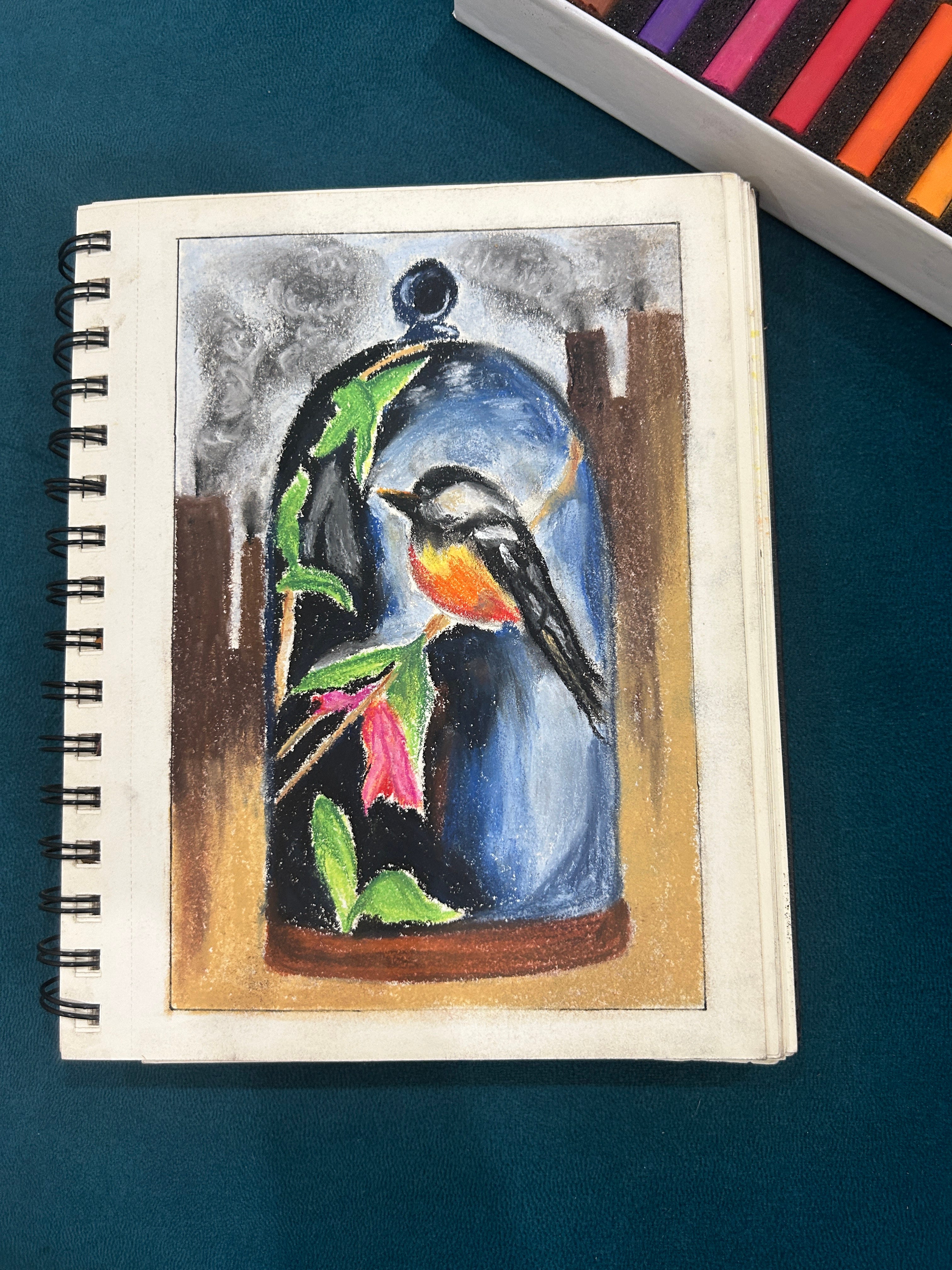
The pastel on this page began as a private act of thinking. A bird, small, vivid, alive, (representing nature), sits inside a bell jar. The jar is sealed. The air is thinning. Outside, the world burns with fuel entirely of our own manufacture, and the bird is beginning to run out of time. This isn’t an accident, but a choice, made slowly, and then all at once.
I kept returning to Esther Greenwood as I worked on it. The moment when she can still see the world through the glass, clearly, and knows exactly what is wrong, and cannot make anyone else see it. That lucidity, that furious, lonely clarity, is what I wanted to render.
Because that is where we are now, ecologically. We have the data. We have the science. We have, if we are honest with ourselves, the grief. The coral bleaches. The glaciers calve. The migration patterns shift and fracture. The forests are on fire, and the food systems are in collapse. We are Esther at the magazine gala, surrounded by forced gaiety, going through the motions, watching ourselves from the outside, wondering how everyone else seems so comfortable inside a world that is visibly, undeniably, on fire.
III. The logic of exploitation
Ecofeminism: the intellectual tradition that links the domination of women and the domination of nature has been making this argument since the 1970s. But it has never felt more urgent than it does now, when the consequences of both are written into the body of the planet at the same scale as they are written into the bodies and lives of women across the world.
The logic is consistent: declare something feminine, and you have already begun the process of marking it as available. Feminine things are soft. They yield. They give. They absorb. They do not complain when they are taken from. They exist, in the logic of extraction, their value measured entirely by their output, their wildness a problem to be managed, their refusal a pathology to be treated.
You cannot separate the story of environmental collapse from the story of whose voices were dismissed when the warnings came. They are the same story.
Esther’s breakdown, in Plath’s telling, is not unwarranted. It is the only rational response to a world that has insisted, over and over again, that her interiority does not matter, that she exists to perform and produce and please, and that her suffering is, at worst, an inconvenience. The earth is having a breakdown in exactly this sense. The floods and the fires and the disappearing species are not disasters that arrived from nowhere. They are the rational consequences of centuries of being told that what she needed did not matter.
IV. Recovery is political
What is hopeful in Plath’s novel, and there is something hopeful, even in its darkness, is that recovery requires, above all, being taken seriously. Dr. Nolan listens. She does not dismiss. She does not prescribe a performance of wellness; she works toward the real thing, slowly, at the cost of comfort.
Ecological recovery asks the same thing of us. Not a performance of sustainability, not paper straws and vegan leather, when mindless wars are being waged, and threats of genocide are being declared in tweets, AI data centers are being built at the cost of water bankruptcy, mangrove forests are being cut to build roads no one asked for. But the actual, discomfiting work of listening. Of taking seriously what has been dismissed.


The idea of Ecofeminism has been in practice for centuries. In India, it looked like women hugging trees in Uttarakhand, preserving seed varieties in Odisha, reviving water sources in Gujarat, and standing in the path of dams on the Narmada. The women most affected by ecological collapse have consistently been the ones working hardest to prevent it. It is high time we bring them to the centre of policy, with real power and not just a symbolic presence.
There is only one planet. That fact should not need restating, and yet here we are, restating it — because somewhere in the noise of markets and power and the performance of progress, it has been quietly set aside.
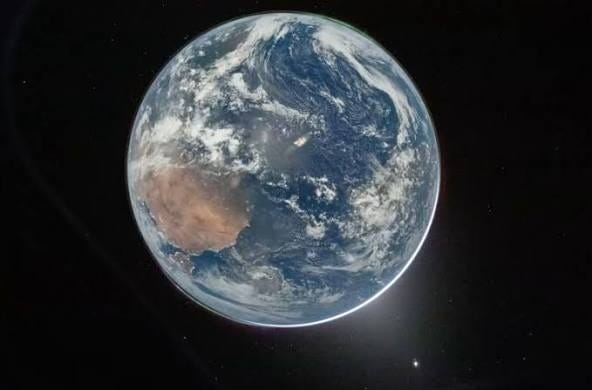
The death of nature is not an environmental issue. It is a human emergency, dressed in the language of ecology, because we have not yet found words urgent enough for what it actually is. Nature dies slowly, in increments, in parts per million, in degrees. And then, for us, all at once.
That, I think, is where we begin, with that knowledge, held plainly, without looking away.